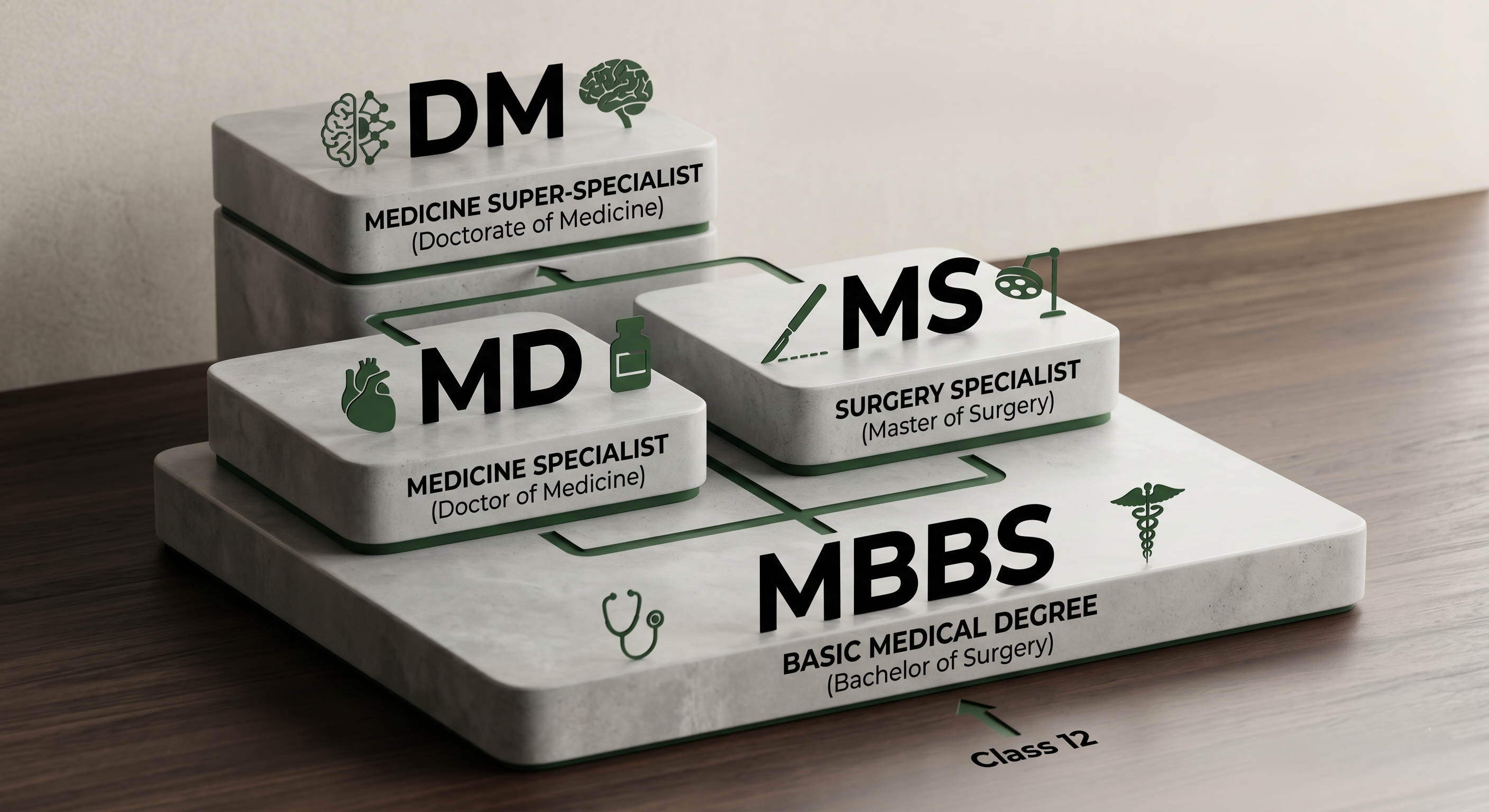
If you want to become a doctor, you may feel confused by terms like MBBS, MD degree, MS, and DM. Many students and parents ask questions like:
- Which degree is higher?
- Who can do surgery?
- Which one gives a better career?
- What is the difference between all these doctor programs?
Well, the answer is actually very simple. In India, the medical education path usually goes like this:
MBBS → MD degree / MS → DM
This means:
- MBBS is the first step to becoming a doctor
- MD degree is for specialization in medicine
- MS is for specialization in surgery
- DM is a super-speciality after MD
This blog will guide everything in a very simple way — what each degree means, how long it takes, who can apply, career options, salary, and the full Doctor of Medicine degree requirements in India.
How Does MBBS Differ from a MD Degree?
What Is MBBS? What Does MBBS Stand For?
MBBS stands for Bachelor of Medicine, Bachelor of Surgery. It is the basic medical degree that students study after Class 12 if they want to become a doctor. In India, MBBS is the first and most important step in all medical careers. Without MBBS, you cannot usually join MD programs, doctor programs, or higher medical specializations. So if you want to become a doctor, MBBS is where the journey begins.
What Do Students Learn in MBBS?
MBBS gives students strong medical knowledge, practical training, and hospital exposure. It teaches both theory and patient care. Here are the main subjects:
Human Anatomy:
Human anatomy is the study of the structure of the human body. Students learn about bones, muscles, organs, nerves, and body systems. It is one of the most important basics in medicine.
Physiology
Physiology teaches how the body works in normal conditions. Students learn how the heart, lungs, kidneys, brain, and other organs function. This helps them understand health and disease.
Pathology
Pathology is the study of diseases. It explains what happens inside the body when a person becomes sick. Students learn how organs, tissues, and cells change during illness.
Pharmacology
Pharmacology is the study of medicines and drugs. Students learn how medicines work, what side effects they may cause, and how doctors prescribe them safely.
Clinical Medicine
Clinical medicine teaches students how to examine patients, understand symptoms, and diagnose illnesses. This is where students start connecting textbook knowledge with real-life patient care.
Surgery Basics
In MBBS, students also learn the basics of surgery. They understand wound care, sterilization, simple procedures, and operation theatre basics. But this does not make them specialist surgeons yet.
Patient Care
Patient care is a very important part of MBBS. Students learn communication, ethics, hygiene, monitoring, and how to support patients properly.
What Can You Do After MBBS?
After MBBS, a doctor can:
- Start general medical practice (after registration)
- Prepare for NEET-PG
- Join MD programs
- Choose MS
- Choose DNB
- Later go for super-specialization like DM
So, MBBS is the foundation, and all advanced doctor programs come after it.
What Is an MD Degree? What Does MD Stand for Doctor?
MD means Doctor of Medicine, and it is a postgraduate medical degree. This means the md degree is studied after MBBS.
What Is a Doctor of Medicine Degree?
A doctor of medicine degree is a higher medical qualification that gives deeper knowledge in a medicine-related specialty. After MBBS, doctors can choose MD programs in fields like:
Internal Medicine
Internal Medicine is the branch of medicine that focuses on diagnosing and treating diseases in adults. It deals with problems like fever, infections, diabetes, blood pressure, and many long-term health conditions.
Pediatrics
Pediatrics is the branch of medicine that focuses on the health of babies, children, and teenagers. Pediatricians treat childhood illnesses, monitor growth, and help with vaccinations and overall development.
Dermatology
Dermatology is the branch of medicine that deals with the skin, hair, and nails. Dermatologists treat acne, allergies, rashes, pigmentation, hair fall, and other skin-related problems.
Radiology
Radiology is the branch of medicine that uses imaging tests to diagnose diseases inside the body. Radiologists study X-rays, CT scans, MRI, and ultrasound to help detect health problems accurately.
Psychiatry
Psychiatry is the branch of medicine that focuses on mental health and emotional well-being. Psychiatrists treat conditions like anxiety, depression, stress, sleep disorders, and other mental illnesses.
Anesthesiology
Anesthesiology is the branch of medicine that deals with pain control and anesthesia during surgeries or procedures. Anesthesiologists help patients stay safe, comfortable, and pain-free before, during, and after operations.
Pathology
Pathology is the branch of medicine that studies diseases by examining blood, tissues, and body fluids. Pathologists help doctors understand the exact cause of illness and support accurate diagnosis. So, the MD degree is for students who want to become specialists in non-surgical branches of medicine.
Is MD Higher Than MBBS?
Yes, the MD degree is higher than MBBS in academic level. Simple order:
MBBS = Basic medical degree
MD degree / MS = Postgraduate specialization
DM = Super-specialty
So yes, the doctor of medicine degree is more advanced than MBBS because it focuses on one special field of medicine.
Who Is Eligible for the MD Degree?
Many students want to know the doctor of medicine degree requirements. To join MD programs in India, you usually need:
- A completed MBBS degree
- One-year internship completion
- Medical registration
- A qualifying score in NEET-PG
These are the basic doctor of medicine degree requirements in India. So, if someone asks about doctor of medicine degree requirements, the simple answer is: First complete MBBS, finish internship, get registration, and clear NEET-PG.
Is MD Only Available After MBBS?
Yes, in India, the doctor of medicine degree is generally available only after MBBS. This is why MBBS is called the base degree. Without MBBS, you usually cannot enter MD programs in the Indian medical education system.
How Long Is MD After MBBS?
In India, the MD degree usually takes 3 years after MBBS. So the total journey becomes:
- MBBS = 5.5 years (including internship)
- MD degree = 3 years
So, MBBS + MD usually takes about 8.5 years total.
MD Degree vs. MS: Choosing Between Medicine and Surgery
After MBBS, most students choose between MD degree and MS. Both are postgraduate doctor programs, but they are different.
- MD Degree: Focuses on medicine (non-surgical specialties)
- MS: Focuses on surgery (surgical specialties)
So the main difference is: MD = Doctor of Medicine and MS = Doctor of Surgery.
Which Is Better: MD Degree or MS?
Neither is better for everyone. It depends on what kind of doctor you want to become.
Choose MD degree if you like:
- Diagnosing diseases
- Long-term treatment
- Patient management
- Non-surgical care
- Medicine-based specialties
Choose MS if you like:
- Surgery
- Operation theatre work
- Hands-on procedures
- Emergency surgical cases
- Surgical specialties
Can an MD Doctor Do Surgery?
Usually, an MD degree doctor does not perform major surgeries like a surgical specialist. Because the doctor of medicine degree trains doctors in medicine-based specialties, not surgical branches. However, depending on the field, some MD doctors may do minor procedures.
For example: Dermatologists may do skin procedures, Radiologists may do image-guided procedures, Gastroenterologists (after DM) may do endoscopy, and Cardiologists (after DM) may do angioplasty-related procedures. But for major surgeries, proper MS or surgical training is usually needed.
The Super-Specialty Level: What is a DM Degree?
Now let’s talk about the highest level in this path. DM stands for Doctorate of Medicine in India’s super-specialty system. It is a super-specialty degree done after MD in a related field. This means DM is for doctors who want very advanced specialization.
Which Degree Is Bigger: MD or DM?
DM is higher than the MD degree. Simple hierarchy: MBBS → MD degree / MS → DM. So if you ask, “Which is bigger: MD or DM?” The answer is: DM is higher.
Super-Specialty DM Branches:
Cardiology
Cardiology is the branch of medicine that deals with the heart and blood vessels. It focuses on heart problems like high blood pressure, heart attack, heart failure, and irregular heartbeat. Cardiologists help diagnose and manage heart disease and may perform advanced heart-related procedures.
Neurology
Neurology is the branch of medicine that focuses on the brain, spinal cord, and nerves. It deals with conditions like stroke, epilepsy, migraine, Parkinson’s disease, and nerve disorders. Neurologists diagnose and treat nervous system problems.
Nephrology
Nephrology is the branch of medicine that deals with the kidneys. It focuses on kidney disease, kidney failure, dialysis care, high blood pressure, and chronic kidney problems. Nephrologists help manage kidney health and advanced renal conditions.
Gastroenterology
Gastroenterology is the branch of medicine that focuses on the digestive system. It deals with the stomach, intestines, liver, pancreas, and gallbladder. Gastroenterologists treat acidity, ulcers, liver disease, and digestive disorders, and may perform procedures like endoscopy.
Salary and Career Progression
Which Degree Has a Better Salary?
In general, the salary trend is: MBBS < MD/MS < DM.
This means: MBBS doctors earn as general doctors or junior doctors, MD degree / MS doctors usually earn more because they are specialists, and DM specialists often earn the highest because they are super-specialized.
But salary depends on many things: Specialty chosen, Government or private hospital, City, Experience, Demand in the market, Private practice, and Reputation/skills.
Final Comparison: MBBS vs MD Degree vs MS vs DM
Here is the easiest way to understand it:
MBBS
First medical degree. Makes you a doctor. Basic medical qualification. Can start general practice after registration.
MD Degree
Postgraduate degree after MBBS. Specialisation in medicine. Non-surgical branch. For students who like diagnosis and patient treatment.
MS
Postgraduate degree after MBBS. Specialisation in surgery. For students who want to become surgeons.
DM
Super-speciality after MD. Higher than the MD degree. Advanced training in a specific medical field. For doctors who want top-level specialisation.
Conclusion
If you want the simplest answer, remember this: MBBS makes you a doctor, MD degree makes you a specialist in medicine, MS makes you a specialist in surgery, and DM makes you a super-specialist after MD.
So in India, the common path is: MBBS → MD degree OR MS → DM. The Doctor of Medicine degree is one of the most important steps after MBBS. It gives deeper specialization, better career growth, stronger job opportunities, and access to advanced doctor programs.
If you are planning your future, here is the easiest advice:
- Choose MBBS if you want to start your journey as a doctor
- Choose MD degree if you love medicine and non-surgical specialties
- Choose MS if you love surgery and operation theatre work
- Choose DM if you want the highest level of specialization in a medicine branch
The doctor of medicine degree in India is highly respected and opens many doors in hospitals, academics, private practice, and super-speciality careers. Becoming a doctor is a dream for many students, and choosing the right medical college is the first step toward that dream. For students living in Durgapur and nearby areas of West Bengal, Gouri Devi Hospital & Research Centre is one of the top medical colleges for quality education, practical exposure, and a strong medical career.