Logo
Home

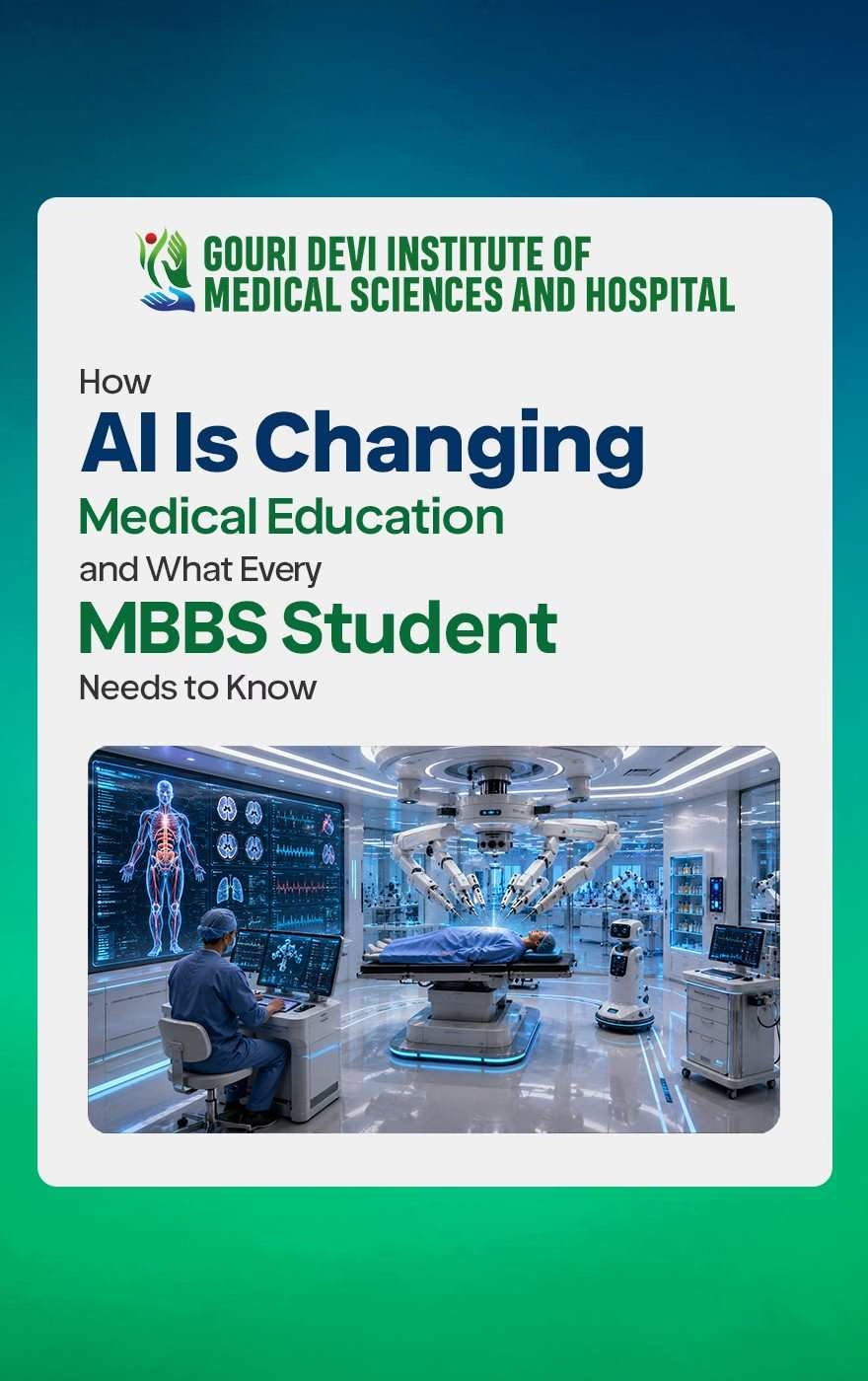
How AI Is Changing Medical Education and What Every MBBS Student Needs to Know

The impact of AI in medical education is no longer something to read about in research papers. It is happening right now, in classrooms and study rooms across the world.

Think about this for a moment. A first year MBBS student sits down to study cardiology. Instead of opening a 900-page textbook and reading until midnight, an AI platform has already analysed that student's weak areas from last week's quiz. It suggests exactly which topics to cover today, generates practice questions at the right difficulty level, and gives instant feedback when an answer is wrong.

That is not the future. That is already happening in medical colleges around the world, and it is coming to India faster than most students and faculty realize.

AI in medical education is not just about using ChatGPT to summarise notes. The impact of artificial intelligence medical education goes deeper than most people realise. It is a deep shift in how doctors are being trained, how anatomy is taught, how clinical skills are practised, and how students prepare for high-stakes exams. This blog breaks it all down simply so every student, parent, and faculty member understands what is changing and why it matters.

How AI Is Changing Medical Education and What Every MBBS Student Needs to Know

What Does AI Actually Mean in Medical Education?

Before anything else, it helps to understand what the term means in this context.

Artificial intelligence medical education refers to the use of computer systems that can learn from data and make decisions to support teaching, learning, and assessment in medical colleges. This includes:

  • Platforms that adapt to each student's learning pace and identify gaps
  • Virtual patients that simulate real clinical cases
  • AI tools that give instant feedback on a student's answers or reasoning
  • Chatbots that answer medical questions 24 hours a day
  • Image recognition tools that help students learn radiology and pathology
  • Administrative systems that track attendance, performance, and exam readiness

In simple terms, AI in medical education means technology that thinks alongside students and faculty, rather than just storing information like a regular computer.

How Is AI Changing the Way MBBS Students Study?

This is where the change is most visible, and most exciting. A 2025 study published in JMIR Medical Education found that personalised AI feedback improves students' clarity of goals, boosts confidence, and increases involvement in learning. That is not a small improvement. That is the kind of shift that changes exam results and clinical performance.

Adaptive Learning

Adaptive learning platforms track what each student knows and adjusts the content in real time. Platforms like Marrow and Prepladder in India already use machine learning to track student performance and customise question sets for NEET PG preparation.

Instant Answers

AI chatbots and large language models can answer questions on pharmacology, anatomy, or pathology almost instantly. A 2024 AMA survey found that 74% of medical students globally already use AI tools to support their studies.

Spaced Repetition

Flashcard and spaced repetition tools powered by AI, such as AI-enhanced versions of Anki, now predict exactly when a student is about to forget a concept and push a revision at the perfect moment.

Automated Generation

Automated question generation means students are no longer limited to the questions in one textbook or one Qbank. AI can generate thousands of new case-based questions from the same source material.

What Are Virtual Patients and Why Do They Matter?

This is one of the most talked-about applications of artificial intelligence medical education, and one of the most useful for clinical training.

A virtual patient is one of the most exciting applications of artificial intelligence medical education right now. It is an AI-generated simulation of a real patient case. The student takes a history, orders investigations, makes a diagnosis, and prescribes treatment. The AI responds the way a real patient would, including giving vague or confusing answers, which is exactly what happens in real clinical settings.

In India, access to a wide variety of clinical cases depends heavily on which hospital a student is posted in. Virtual patients solve that problem by giving every student access to the same range of cases, regardless of geography or hospital size.

Why does this matter?

  • Students can practise rare or complex cases that they may never see during their clinical postings
  • Mistakes in a virtual environment carry no risk to a real patient
  • Students can repeat the same case multiple times until they get it right
  • Research by Pottle (2019) showed that students who engage with AI-augmented simulations demonstrate improved procedural skills and better critical thinking

How Is AI Being Used to Teach Anatomy and Radiology?

Two subjects where students traditionally struggle the most are being transformed by AI in medical education.

Anatomy

Traditional cadaver dissection is irreplaceable. But one area where artificial intelligence medical education is making a real difference is in supplementing that learning with AI-powered 3D anatomy tools. They now allow students to rotate organs, isolate structures, zoom into nerve pathways, and test themselves interactively. Tools like Complete Anatomy and AI-enhanced digital models are already used in many institutions globally. Indian medical colleges are beginning to integrate these tools alongside traditional dissection.

Radiology

AI image recognition tools can analyse X-rays, CTs, and MRIs. For MBBS students learning radiology, AI tools can highlight structures, point out abnormalities, and quiz students on what they see. This kind of interactive learning is far more effective than staring at printed films or passively watching a senior report a scan.

A 2025 article in The Lancet Digital Health noted that AI holds particular promise for high-fidelity clinical training because it can present realistic scenarios that experienced faculty simply do not have the time to run manually for each student.

Does AI Help with NEET PG and Exam Preparation?

Yes, and this is where Indian students are already benefiting the most from artificial intelligence medical education.

Platforms like Marrow, Prepladder, Doctutorials, and Unacademy use AI-driven algorithms to:

  • Track which subjects a student consistently scores low in
  • Identify which subtopics within a subject are weak, not just the subject as a whole
  • Adjust the difficulty of questions based on recent performance
  • Predict exam readiness scores based on practice test patterns
  • Send targeted revision reminders for topics the student is about to forget

A 2025 systematic review published in Medical Education Online found that AI technologies like adaptive learning platforms showed significant improvement in knowledge retention and exam performance among medical students.

For a student preparing for NEET PG, this means studying smarter, not just longer.

What Is an AI in Medical Education Course and Should Students Take One?

This is a growing question as more colleges start offering structured training on this topic.

An AI in medical education course is a programme designed to teach medical students and faculty how to understand, use, and critically evaluate AI tools in a healthcare context. These courses cover:

  • Basics of how AI works in healthcare settings
  • How to use AI tools responsibly without over-relying on them
  • Understanding AI limitations, including hallucinations and bias
  • How AI is used in diagnosis, imaging, and clinical decision support
  • Ethical considerations around patient data and AI recommendations

Several global institutions including medical schools in the US, UK, and Australia have added AI literacy as part of the core curriculum. In India, the movement is still early but growing. Some institutions now offer elective workshops and sessions on digital health and AI tools.

Should MBBS students take one? Absolutely. Artificial intelligence medical education is moving from a niche interest to a core professional skill. A 2025 Indian survey of MBBS students found that 56.7% had received no prior AI training but almost all of them expressed a strong interest in learning. The doctors of tomorrow will work alongside AI tools every single day. Understanding how those tools work is no longer optional knowledge.

What Are the Risks and Concerns Around AI in Medical Education?

It would not be an honest blog if it only listed the positives.

Hallucinations

AI can give wrong answers. Language models sometimes produce confident-sounding but incorrect medical information. A student who blindly trusts an AI answer without verifying it is picking up a dangerous habit.

Over-dependence

This is a real risk. If students use AI to get answers rather than to understand concepts, their clinical reasoning skills may actually weaken. The goal of AI in medical education is to support thinking, not replace it.

Unequal Access

Not all students have equal access. In India, the quality of internet access, devices, and digital infrastructure varies enormously between urban private colleges and rural government colleges. This creates an uneven playing field.

Ethics & Faculty Lag

When patient data is used to train AI tools, questions about consent and privacy arise. Additionally, a 2025 JMIR study noted that many faculty members feel underprepared to integrate AI into teaching, leading to misuse or underuse.

These are not reasons to avoid artificial intelligence medical education. They are good reasons to approach it thoughtfully and critically.

How Should Medical Students in India Approach AI Right Now?

Practical guidance matters more than theory here. Here is what students can actually do today:

  • Use Purpose-Built Tools Start with AI tools that are purpose-built for medical education rather than generic tools. Platforms like Marrow, iatroX, and Osmosis AI are designed with medical accuracy in mind and are safer than general chatbots for clinical learning.
  • Find Weak Areas, Not Just Answers Use AI to find your weak areas. The most valuable thing an adaptive platform can tell a student is not the answer to a question but which questions the student keeps getting wrong and why.
  • Verify Everything Always verify AI-generated information against a standard textbook or trusted source before treating it as fact. AI is a starting point, not a final authority.
  • Take AI Courses If a college or institution is offering any form of AI in medical education course, take it seriously. These are skills that will be part of medical practice for the entire career ahead.
  • Don't Forget the Human Element Remember that AI does not replace clinical intuition, empathy, or the ability to sit with a patient and make them feel heard. Those skills are still built the old-fashioned way, through patients, experience, and time.

What Does the Future of AI in Medical Education Look Like?

The direction is clear. AI in medical education is not a trend that will pass. It is becoming part of the infrastructure of how medicine is taught.

In the near future, medical students can expect:

  • Personalised AI tutors that follow a student across all five and a half years of MBBS, tracking progress and adjusting support
  • AI-generated OSCE scenarios for clinical skill assessment
  • Augmented reality surgical training that gives real-time feedback on technique
  • AI tools that flag struggling students early, so faculty can intervene before a student fails an exam

Institutions like Gouri Devi Institute of Medical Sciences and Hospital (GIMSH) in Durgapur that are actively building modern, tech-aware clinical training environments so that graduates are ready for a healthcare system where AI is already embedded in practice.

The students entering MBBS today will be the doctors who work alongside AI for the next 30 to 40 years. Starting to understand it now is not getting ahead of the curve. It is simply keeping pace with where medicine is already going.

Conclusion

AI in medical education is changing things in ways that cannot be ignored. It is making learning more personalised, clinical practice more accessible, and exam preparation more targeted. It is also raising real questions about over-dependence, ethics, and equal access that every student and faculty member needs to think about.

The answer is not to resist it or blindly follow it. The answer is to understand it well enough to use it wisely. The best doctors of the next generation will not be the ones who studied the hardest in the most traditional way. They will be the ones who knew when to trust their clinical instincts and when to let artificial intelligence medical education tools sharpen those instincts further. Medicine has always evolved. AI is simply the next evolution. Get ahead of it now.