
You finished MBBS. Five and a half years of hard work — done. But if a radiology course is the branch you want, you already know the real fight is just starting.
Many of you want to do a PG in radiology. The seats are few. The competition is brutal. And most blogs you read give you rank numbers from 2021 that are not of any help today.
This guide gives you real numbers from 2024 MCC data. No fluff and no guesswork. Whether you are targeting an MD, a DNB, or a PG diploma in radiology, the answer is here.
Let us be honest about this. There are real reasons doctors chase this path and none of them are just about prestige.
You sit at the center of every clinical decision. Ask any surgeon. They will not touch a patient without reviewing the scans first. Ask any oncologist. The treatment plan does not move without imaging. A radiology course after MBBS puts you in that room, the one where the important calls actually get made.
The lifestyle of a radiologist is genuinely good. No 3 AM calls because someone's BP dropped. No ward rounds that eat your entire morning. The work has real pressure but it runs on a schedule.
The financial reality of a radiology career is genuinely good. Setting up a diagnostic centre takes serious capital. That same barrier keeps too many people from entering and crowding the field. A qualified radiologist in a well-run practice earns among the best in Indian medicine.
Building something of your own is a real option here. Partnerships in diagnostic centres, independent setups, consultant arrangements with hospitals. This specialty gives you room to build, not just work.
Demand for radiology technicians and doctors is only going up. Modern medicine runs on imaging. More hospitals are opening. More patients expect a scan before any major decision gets made. Trained radiologists are needed far faster than they are being produced.
So choosing a radiology course after MBBS is a genuinely smart long-term career move.
Yes. No shortcut here.
To work as a clinical radiologist in India, to legally read scans and sign reports, you must clear either NEET PG or INI-CET.
Every radiology PG course seat, whether MD, DNB, or diploma in radiology is filled through centralised counselling, based on your rank. No exam, no seat. It’s as simple as that.
Most articles still use 2021 data. Cutoffs have tightened a lot since then. Here are the actual 2024 MCC closing ranks.
AIQ gives you access to 50% of all government PG seats across India. Anyone can apply, regardless of their home state. That makes it very competitive.
Top government colleges are in a completely different league. If this is your target, you need to score exceptionally:
That means you need to be in the top 35 doctors in the entire country. Not top 150. Top 35.
Other government colleges are more achievable. For most state-level government medical colleges, the closing rank for MD Radiodiagnosis in the general category is roughly:
This changes by state, so always verify on mcc.nic.in before your counselling.
DNB seats at good corporate hospitals are popular and competitive now. Closing ranks typically fall between AIR 4,500 and 9,000, depending on the hospital.
Big hospitals in metro cities — Apollo Delhi, Medanta — close earlier in that range. Smaller accredited centres in tier-2 cities close later.
One thing many people overlook about a radiology PG course through DNB is this. A busy corporate hospital processing 500 or more scans every single day gives you a volume and variety of clinical exposure that is genuinely hard to match anywhere. The degree on your certificate matters, of course. But what shapes you as a radiologist is the caseload you actually sit with during those training years. A DNB seat in the right hospital can give you exactly that.
If your rank is beyond the government window, you still have good options.
One request: if you are choosing a private college, please do not just look at the rank cutoff or the fee. Go visit the department. Ask how many scans they do daily. Talk to current residents and ask if they actually get to hold the probe themselves. A good private radiology PG course seat is genuinely worth it. A bad one is three wasted years.
One of the most common questions from students planning a PG in radiology is about the time commitment. Here is the radiology course duration for each pathway:
| Programme | Duration |
|---|---|
| MD Radiodiagnosis | 3 years |
| DNB Radiodiagnosis | 3 years |
| PG Diploma in Radiology (DMRD) | 2 years |
If you get a DMRD seat and later want a full specialist degree, you can do a secondary DNB after that. It takes roughly one to two more years. So, a PG diploma in radiology is not a dead end. It is just a longer route to the same destination. Many doctors have taken this path and built excellent careers in their radiology specialisation.
No. This confuses a lot of people, so let's clear it up.
A BSc Radiology student is trained to become a radiographer or technologist. They learn to operate imaging machines, positioning patients, running CT and MRI protocols, and maintaining equipment. That is a skilled job and an important one.
But they cannot read scans, make diagnoses, or sign a radiology report. Only a doctor, MBBS + MD/DNB Radiodiagnosis, can do that.
People who complete an x-ray technician course or enter a radiologic technology program have a very different career path from a clinical radiologist. They work alongside radiologists but do not replace them.
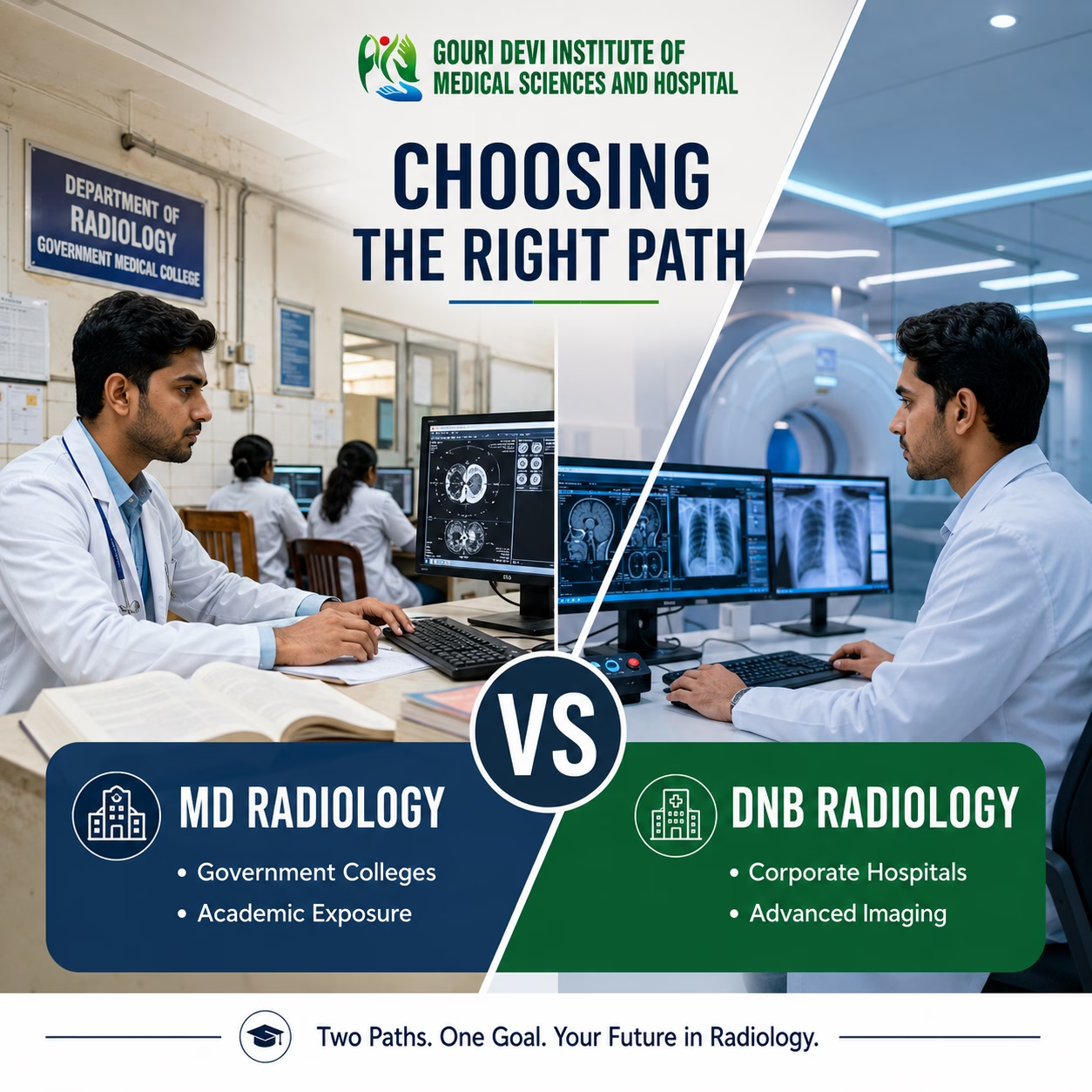
If you ask honestly, the NMC treats both as equal now. That debate is mostly over. The real question is: where will you actually train?
| Feature | MD Radiodiagnosis | DNB Radiodiagnosis |
|---|---|---|
| Where | Government medical college | Corporate or trust hospital |
| Cases | High volume, lots of routine work — good for building speed | Complex tertiary cases, advanced imaging protocols |
| Exam | University-run, steady pass rates | NBE-run, stricter but improving |
| Good for | Academic career, teaching, clinical work | Corporate hospitals, private practice |
Pick based on where you will learn. Not the letters on the certificate.
No. You need an MBBS from an NMC-recognised college. You also need to have completed your one-year rotatory internship. Both are compulsory.
Without MBBS, you can only enter the imaging field through allied health paths i.e a radiologic technology program or an x-ray technician course. These are real career options, but they do not give you the authority to diagnose or sign a report, as we discussed before.
You will hear this question a lot. Here is the real answer.
AI is good at specific tasks like spotting a nodule in a chest CT, measuring tumour size, flagging early stroke signs. It is fast and does not get tired.
But AI cannot do this: call the surgeon to understand a patient's history. Figure out that the "new mass" on the scan is actually an old keloid that has not changed. Do a real-time ultrasound-guided biopsy. Handle an unusual case with findings in five different organs.
That clinical thinking, that human judgment AI does not have. What is going away is the radiologist who only reports plain X-rays and does nothing else. Be more than that, and your place will be secured.
Counselling is stressful and fast. Before choices lock in, spend some time thinking about these three things.
This is the most important question in any radiology course evaluation. This sounds basic. It is not. Ask the specific machines in the department - 1.5T or 3T MRI, how many CT slices, daily Doppler ultrasound volume. A department where the MRI has been down for months is not teaching you MRI.
In any radiology course, CT and MRI can partly be learnt at a workstation. Ultrasound cannot. It is a hands skill. If first and second year residents are doing scans themselves, that is a good sign. If they only watch, that is a red flag.
Guided biopsies, drainages, vascular procedures - this is where the field is growing. If the department has a DSA lab or an active IR programme, you will graduate knowing things most of your peers do not. Ask about it.
Securing a PG in radiology is not something that happens by accident. It takes hard work and preparation, a strong rank, smart counselling, and then three years of serious learning once you get there.
Before you plan for a PG in radiology, here is a quick summary of the numbers. Use this as your starting point, then verify on mcc.nic.in:
Use 2024 or 2025 data to plan your PG in radiology target, not cutoffs from 2021 or 2022. Check mcc.nic.in. Talk to actual residents at the colleges you are targeting.
And when you do get that seat, in whichever radiology course or radiology PG course it is, learn everything. The machines, the anatomy, the hands-on scans, the interventions. The rank only opens the door. How you excel inside is entirely up to you.